

Blog Archives


Blog Archives
Border Reiver Clans and the Act of 1587: Scotland’s Legally Recognised Riding Clans
A common misconception is that the Border Reivers were later transformed into clans in imitation of the Highlands. In reality, the Border Reiver families functioned as kinship-based clans from their earliest development.
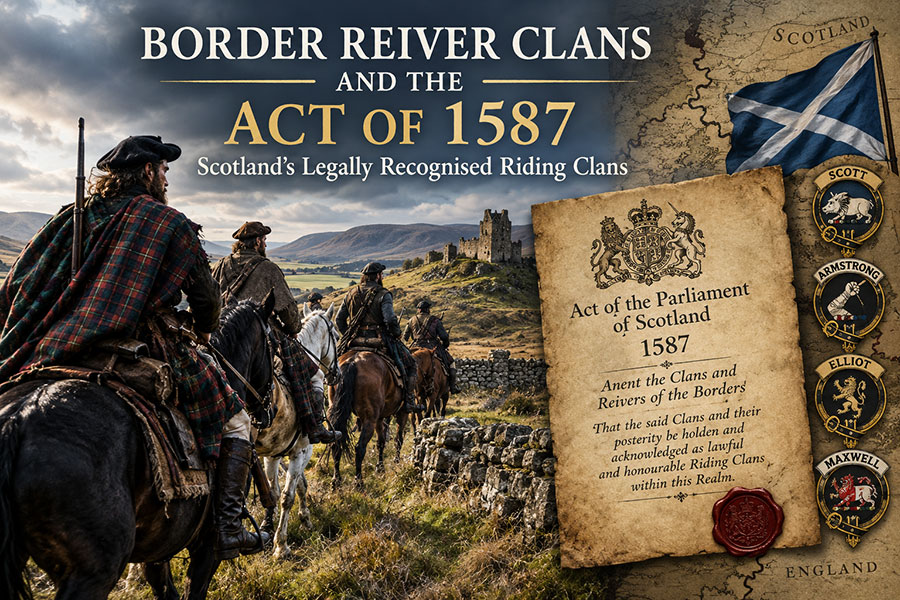
Between the thirteenth and fifteenth centuries, these extended family networks evolved organically across the Anglo-Scottish border, forming powerful social, military, and territorial communities that shared many of the characteristics associated with Highland clans.
The distinction often drawn between Highland and Lowland society can obscure the fact that clan organisation was not unique to the Highlands. In Scotland’s border regions, families organised themselves around blood ties, mutual protection, and loyalty to a recognised head of the name. These kinship groups became known in law and government records as “Surnames” or riding clans, reflecting their mobile, horse-based culture and their ability to mobilise large numbers of armed relatives and dependents.
Historically, the terms clan and family were frequently used interchangeably throughout Scotland. In the Lowlands and Borders, a “family” often referred not simply to a household but to an entire kinship grouping under a common surname and leadership. As a result, many of the great Border names operated in a manner comparable to their Highland counterparts, even though their customs, geography, and political circumstances differed.
Act for the Suppression of Unruly Clans
The strongest evidence for the official recognition of these Border clans came with the Act for the Suppression of Unruly Clans, passed by the Scottish Parliament under King James VI in 1587. This landmark legislation was intended to bring greater control to areas where powerful kinship groups dominated local affairs. Rather than creating clans, the act acknowledged their existence and sought to regulate them.
Under the statute, clan chiefs and principal representatives were held jointly responsible for the actions of their surname. They could be called to account for crimes, debts, and disturbances committed by members of their kin group. The legislation demonstrates that the Scottish Crown recognised these families as organised social and political entities with identifiable leadership structures.
Among the Border families specifically named in the legislation were seventeen clans or surnames resident in the West March. These included well-known Border names such as Carruthers, Scott, Irving, Johnstone, Graham, and Bell, alongside other prominent riding families such as Armstrong, Maxwell. Their inclusion in parliamentary legislation confirms that they were regarded as distinct clans whose leaders could exercise authority over their followers.
The Lord Lyon King of Arms
The legacy of these Border clans continues into the modern era. Today, official recognition within Scots heraldic law depends upon the existence of a chief recognised by the Lord Lyon King of Arms, Scotland’s heraldic authority. A clan with a confirmed Chief Of The Name and Arms enjoys full official status under Scottish clan law. Some Border clans, such as Clan Carruthers, have successfully secured recognition of their chief in recent years. Others remain classified as armigerous clans, meaning they possess clan identity and heraldic history but currently have no officially recognised chief.
Within Clan Irving, and indeed among many Border descendants, discussion frequently centres on the similarities and differences between Highland and Lowland clanship. While Highland clans developed distinctive cultural traditions linked to Gaelic society, Border clans emerged within a different environment shaped by frontier warfare, cross-border raiding, and the unique demands of life along the Anglo-Scottish Marches. Nevertheless, both systems rested upon the same fundamental principles of kinship, loyalty, collective responsibility, and leadership.
The Border Reiver Heritage Society
These questions of identity, history, and legal recognition continue to be explored by organisations such as the Border Reiver Heritage Society, which promotes research into the culture and history of the riding surnames. Their work highlights an important historical reality: the Border Reivers were not clans in waiting, nor were they later converted into clans.
They were clans from their inception, recognised by their contemporaries, acknowledged by the Crown, and ultimately enshrined in Scottish law through the Act of 1587.