

Blog Archives


Blog Archives
The Rough Wooing 1543-1551 and Its Impact on the Scottish Borders
The Rough Wooing was a series of military campaigns conducted by England against Scotland between 1543 and 1551. Initiated by King Henry VIII, the conflict aimed to force a dynastic union between the two kingdoms through the marriage of his son, Prince Edward, to the infant Mary, Queen of Scots.
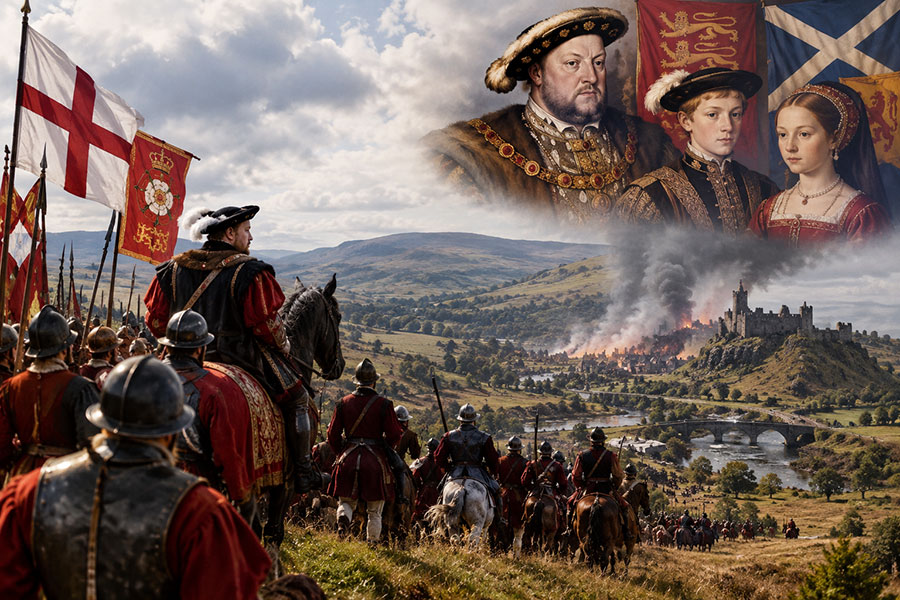
Although the English objective was presented as a diplomatic match, the aggressive military tactics employed gave rise to the term “Rough Wooing.” The war had profound consequences for Scotland as a whole, but its effects were especially severe in the Scottish Borders, where communities suffered repeated invasions, destruction of property, economic disruption, and long-lasting social instability.¹
Origins of the Rough Wooing
The conflict began after the death of King James V of Scotland in December 1542. His infant daughter, Mary, inherited the Scottish throne. Hoping to secure peace and extend English influence, Henry VIII proposed the Treaty of Greenwich (1543), which arranged Mary’s future marriage to Prince Edward.²
However, many Scots opposed the agreement, fearing the loss of Scottish independence. Influenced by pro-French nobles and longstanding hostility towards England, the Scottish Parliament rejected the treaty. Henry VIII responded with military force, seeking to compel Scottish acceptance of the marriage.³
The Course of the Conflict
English armies launched a series of devastating raids into Scotland. One of the most notable early attacks occurred in 1544 when the Earl of Hertford, later Duke of Somerset, led an expedition that burned much of Edinburgh and caused widespread destruction throughout the Lothians.⁴
The war intensified after Henry VIII’s death. Under Edward VI’s government, English forces achieved a major victory at the Battle of Pinkie Cleugh in September 1547. Despite this triumph, England failed to achieve its political objectives. Scottish resistance continued, supported increasingly by France. In 1548 Mary, Queen of Scots, was sent to France for safety and later married the French Dauphin, effectively ending English hopes for the proposed Anglo-Scottish union.⁵
Impact on the Scottish Borders
Widespread Destruction
The Scottish Borders bore some of the worst consequences of the Rough Wooing. As the frontier between England and Scotland, the region became a primary target for military operations. English forces repeatedly crossed the border, burning towns, villages, farms, and religious institutions.⁶
Settlements such as Kelso, Jedburgh, Melrose, and other Border communities experienced repeated attacks. Monasteries and abbeys, already weakened by earlier religious and political changes, suffered extensive damage. The destruction of homes, crops, and livestock left many inhabitants impoverished.⁷
Economic Disruption
Agriculture formed the basis of the Border economy. Repeated military incursions devastated farmland and interrupted normal patterns of cultivation and trade. Farmers often abandoned fields because of insecurity, while markets became difficult to maintain.⁸
Livestock theft, already a feature of Border life, increased during the conflict. Trade routes were disrupted, reducing commerce and exacerbating local poverty. Recovery was slow, particularly in areas subjected to repeated raids.⁹
Border Communities and Frontier Families
The impact of the Rough Wooing was felt not only in towns and monasteries but also among the great Border riding families whose estates lay directly in the path of English invasions. Across Annandale, Eskdale, Teviotdale, and the Merse, landowners found themselves responsible for defending their tenants, protecting livestock, and maintaining local order amid almost continuous warfare.¹¹
Among the families affected were the Irvings of Bonshaw, whose stronghold, Bonshaw Tower, stood near the River Kirtle in Annandale. Situated close to the Western March, the Irvings occupied territory that was particularly vulnerable to incursions from across the border. Like many Border Clans, they relied upon fortified residences, armed retainers, and kinship alliances to safeguard their lands. The insecurity created by the Rough Wooing reinforced the military character of the Irving family and strengthened their dependence upon local networks of mutual defence.¹²
The Carruthers of Holmains were similarly affected. As one of the leading landed families of Annandale, they controlled significant estates around the lower Annan valley. Holmains lay within a region frequently traversed by armies, raiding parties, and messengers moving between Scotland and England. The destruction of crops, loss of livestock, and disruption of commerce placed heavy burdens on Carruthers tenants and reduced the prosperity of the district. As royal officials and local magnates, the Carruthers were expected not only to defend their own property but also to help maintain authority in a region increasingly marked by instability.¹³
For both the Irvings and the Carruthers, the war accelerated developments already underway within Border society. Tower houses were strengthened, kinship ties became more important, and the maintenance of armed followers became essential for survival. In such conditions, distinctions between military service, local defence, and private feuding were often blurred.¹⁴
The Rough Wooing also affected relationships among neighbouring Border surnames. Families including the Irvings, Carruthers, Johnstones, Maxwells, Bells, and Armstrongs were drawn into a complex network of alliances and rivalries shaped by both national politics and local interests. Cooperation was often necessary for defence, yet competition for land, influence, and livestock remained constant. The upheavals of the 1540s intensified these tensions and contributed to the turbulent atmosphere that characterized the Borders for decades afterwards.¹⁵
While the major campaigns and battles of the Rough Wooing were directed by kings, nobles, and professional soldiers, the burden of the conflict fell heavily upon frontier communities. For families such as the Irvings of Bonshaw and the Carruthers of Holmains, the war meant destroyed property, disrupted livelihoods, military obligations, and a constant struggle to preserve their estates and way of life.
Strengthening of Border Militarisation
The Rough Wooing reinforced the militarised character of the Borders. Landowners and local families invested in stronger defensive buildings and maintained armed retainers. Towers, fortified houses, and defensive enclosures became increasingly important features of the landscape.¹⁶
The experience of constant warfare contributed to the development of a culture accustomed to raiding, defence, and frontier conflict, characteristics that would continue to shape Border society throughout the sixteenth century.
Growth of Border Reiving
Although Border reiving predated the Rough Wooing, the conflict intensified lawlessness. The breakdown of authority and economic hardship encouraged raids, theft, and feuding among Border families. Clans and surnames such as the Armstrongs, Elliots, Scotts, Johnstones, Irvings, and Carruthers became closely associated with the turbulent conditions of the frontier.¹⁷
The instability created during the Rough Wooing helped sustain a cycle of violence that continued long after the formal end of the conflict.
Long-Term Consequences
The Rough Wooing ultimately failed in its primary objective. Rather than bringing Scotland under English influence, it strengthened the Franco-Scottish alliance and encouraged greater Scottish resistance to English intervention. The marriage of Mary to the French Dauphin represented a significant diplomatic defeat for England.¹⁸
In the Borders, however, the consequences endured for decades. Economic recovery was gradual, religious buildings remained damaged, and patterns of militarisation and reiving persisted. Families such as the Irvings of Bonshaw and the Carruthers of Holmains continued to operate in a frontier society shaped by insecurity and the need for self-defence. The experience deepened historical memories of conflict between England and Scotland and contributed to the distinct identity of Border communities.¹⁹
Ironically, the dynastic union sought by Henry VIII was eventually achieved not by force of arms but through peaceful succession. In 1603, James VI of Scotland inherited the English throne as James I of England, establishing the Union of the Crowns.²⁰
Conclusion
The Rough Wooing was one of the most destructive Anglo-Scottish conflicts of the sixteenth century. Conceived as a strategy to force a royal marriage, it instead produced widespread devastation and political failure. The Scottish Borders suffered particularly heavily, enduring repeated raids, economic disruption, population displacement, and increased militarisation. Frontier families such as the Irvings of Bonshaw and the Carruthers of Holmains exemplify how the conflict affected ordinary communities as well as kingdoms, forcing generations of Borderers to adapt to violence, uncertainty, and continual threats to their livelihoods.
Although the conflict ended in the early 1550s, its effects shaped Border society for generations, leaving a lasting legacy in the history and identity of the region.