

Blog Archives


Blog Archives
The Heraldic Arms of Irving of Bonshaw
The heraldic Arms of the Irvings of Bonshaw constitute a central element of the clan’s identity, embodying lineage, authority, and symbolism within the framework of Scottish heraldry. As recognised by the Court of the Lord Lyon, the Arms of the Chief represent only the individual bearer and not the wider Clan under their leadership.
The Arms of Irving of Bonshaw are notable for their simplicity of design and strong symbolic continuity, particularly through the repeated use of holly leaves and the enduring motto.
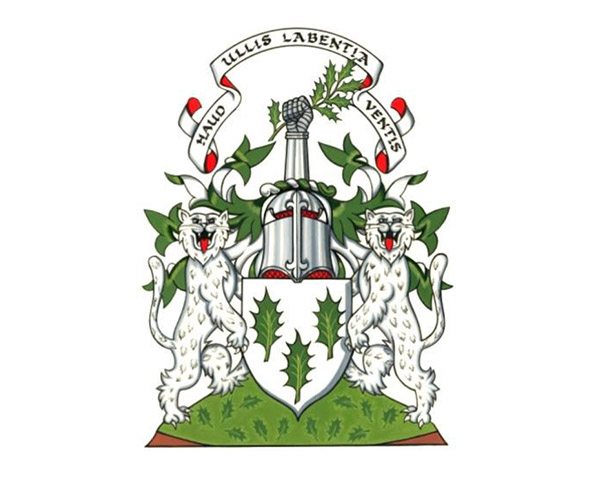
The Blazon and Heraldic Achievement
The formally recognised blazon of the Chief’s Arms is:
Argent, three holly leaves proper.
In heraldic terms, this describes a silver (white) shield bearing three natural-coloured holly leaves. Above the shield is a helmet appropriate to the rank of the bearer, with mantling described as vert (green) doubled argent (white).
The full heraldic achievement includes –
- Crest: An arm in armour (gauntleted) holding a branch of holly with seven leaves.
- Motto: Haud Ullis Labentia Ventis (“Yielding Under No Winds”).
- Supporters (granted to the Chief): Two snow leopards rampant guardant.
- Compartment: Typically strewn with holly leaves beneath the shield.
Together these elements form the complete Armorial Achievement of a Scottish Clan Chief. The inclusion of Supporters is a distinction reserved for certain ranks, persons deemed notable, or organisations of significant status, as well as lawfully recognised Scottish Clan Chiefs.
Symbolism of the Holly
The most distinctive feature of the Arms is the holly leaf, appearing both on the shield and in the crest.
Canting Symbolism
The holly may be interpreted as a canting device – a visual pun possibly linked to the “Irving/Irvine” name, where plant imagery evokes the “vine” or “green” element of the name.
Qualities of Strength and Resilience
More broadly, the holly has traditionally symbolised endurance and resilience. Its’ tough, evergreen foliage conveys ideas of steadfastness, protection and survival, all qualities long associated with the Border Clans and Families.
The Crest: Authority and Leadership
In the crest, the holly branch is grasped by an armoured arm, a traditional emblem of martial authority and leadership. The imagery has been interpreted as representing the Chief’s authority over a hardy and independent kindred, while reinforcing the themes of strength and continuity embodied throughout the armorial bearings.
The Motto: “Haud Ullis Labentia Ventis”
The motto of the Irvings of Bonshaw in Latin, “Haud Ullis Labentia Ventis”, translates as “Yielding Under No Winds”.
This phrase generally expressed in Latin expresses steadfastness and resistance to external pressures – an apt reflection of a Border Clan with a history of conflict and endurance.
Scholarly interpretations trace the phrase to Virgil’s Georgics, suggesting a classical literary influence typical of heraldic mottoes.
Heraldic Development and Variation
Most early armorials only contain details of shields, as this is the only exclusive element of a Coat of Arms, but that does not mean that crests were not used from a very early period. Early Irving/Irvine seals do not show crests but both Drum and Bonshaw may have used them.
By the early modern period, the full heraldic achievement – including crest and motto – had developed and become standardised.
Successive confirmations and matriculations by the Court of the Lord Lyon have reaffirmed these Arms, ensuring their continuity as the official bearings of the Chief of the Name and Arms of Irving of Bonshaw and, by extension, the recognised emblem of the Clan.
The Arms in Clan Identity
In Scottish heraldry, Arms belong strictly to individuals rather than entire surnames. However, the Chief’s Arms function as the symbolic Arms of the clan, with members permitted to display a crest badge derived from the Chief’s crest and motto.
The Irving crest badge – commonly worn by clan members – features:
- A belt and buckle enclosing
- The arm holding the holly branch
- Surrounded by the motto shown on the belt
This distinguishes it from the full Armorial Achievement, which remains the exclusive prerogative of the Chief
Conclusion
The heraldic Arms of Irving of Bonshaw representing a distinguished example of Scottish Clan heraldry. Their restrained yet distinctive design, centred upon the holy leaf and reinforced by a classical motto, expresses enduring themes of resilience, continuity and leadership.
Rooted in medieval heraldic tradition and refined through subsequent centuries of heraldic practice, the Arms have remained a powerful visual expression of the history and identity of the Border Irvings.
Through continued recognition and confirmation by the Court of the Lord Lyon, they remain the living heraldic emblem of the Chief and the Clan of Irving of Bonshaw.