

Blog Archives


Blog Archives
The link between Irving of Bonshaw and Irvine of Drum
The relationship between the Irvings of Bonshaw in Dumfriesshire and the Irvines of Drum in Aberdeenshire has long been a subject of interest among genealogists, clan historians, and members of the wider Irvine & Irving family.
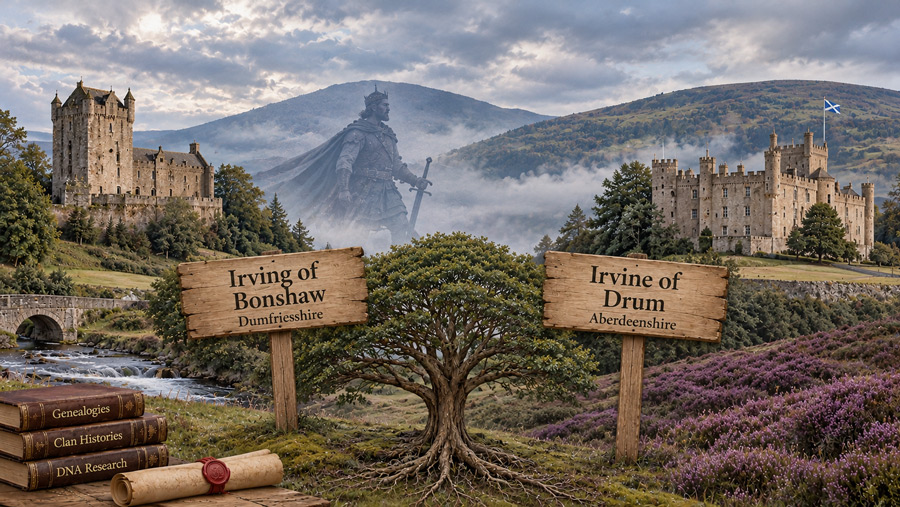
Both families share closely related surnames, similar heraldic traditions, and a body of historical literature that frequently treats them as branches of a common ancestral stock. However, the nature and certainty of that connection has evolved as new documentary and genetic evidence has emerged.
The Legend
There is a legend that on his flight from the English Court at Westminster, Robert the Bruce and his entourage sought refuge in the Borders of Scotland and on one occasion was taken in by the Irvings of Bonshaw. During his period of refuge, the legend states he was hidden in a cave in cliffs just down the Kirtle Water from Bonshaw Tower and that can still be visited, known as Bruce’s Cave.
In recompense for this act of loyalty, the legend goes on to state that one of the sons of Irving of Bonshaw was taken into Royal Service and over time was eventually rewarded with the grant of land by Royal Charter of the Forest of Drum.
At that time, the Monarch was looking for loyal and committed servants of the Crown to appoint to strategically important positions and one of those positions at the time happened to be the Forest of Drum. This also included a fortified Tower that was modified over time and eventually became known as Drum Castle.
The reality is that it is more likely the second son was taken into Royal Service and not the eldest or any other sibling. In those days, it was common practice for the eldest child to inherit the family estate, titles and funds if any, and the second child had to seek fame and fortune elsewhere. If there were any daughters, these were often married off and hopefully to a rich family.
It is most probable this second son worked their way through the various positions within the Royal Household to achieve a senior position where they came to the attention of the Monarch and his advisors.
History tells us that William De Irwyne 1st of Drum, in 1323 was granted by Royal Charter from David II, the Forest of Drum with the barony created 1324. He died in 1333 and it was his successor Thomas De Irwyne 2nd of Drum who succeeded.
The Irvines of Drum are a renowned and respected Scottish Family with a proven lineage. Their present Chief is Alexander Irvine of Drum 27th Baron.
Historical Traditions of Common Ancestry
The traditional view holds that the Irvings of Bonshaw and the Irvines of Drum descend from a common medieval family. This tradition was preserved in genealogical works associated with Dr. Christopher Irvin (or Irvine), whose seventeenth-century account, “The Original of the Family of the Irvines or Erinvines”, became highly influential in later clan histories. Modern collections of Irvine and Irving genealogical material continue to treat the Bonshaw and Drum families together and include parallel family trees for both houses.
The enduring importance of this tradition is reflected in the existence of a dedicated “Family Tree of the Royal Houses, Irving of Bonshaw and Irvine of Drum,” compiled by Edward J.B. Irving in the twentieth century. The very creation of such a genealogy demonstrates the longstanding belief that the two families shared deep ancestral roots.
The Two Principal Families
The Irvines of Drum are among the most distinguished landed families of northeast Scotland. According to modern clan sources, they were granted custody of the Forest of Drum by King Robert the Bruce in 1324 and received the Barony of Drum in 1326. The family has remained associated with Drum Castle and its estate for nearly seven centuries.
The Irvings of Bonshaw, by contrast, developed as a prominent Border family in the southwest of Scotland.
Their Chiefly line is associated with Bonshaw Tower in Dumfries and Galloway and has maintained a documented succession of chiefs dating from at least the early sixteenth century. Recent research cited by the current Chief suggests evidence for Irving activity in the region as early as the twelfth century.
Although geographically separated, both families occupied important positions within Scottish society and preserved traditions emphasising a shared surname heritage.
Surname Origins and Historical Identity
One reason the Bonshaw – Drum connection has attracted attention is the fluid historical spelling of the surname. Modern forms such as Irvine, Irving, Irwin, and Urwin all appear in historical records.
Researchers involved in the Clan Irwin Surname DNA Study note that spelling variations alone are not reliable indicators of distinct ancestry and that the modern forms of the surname emerged from a common historical naming tradition.
The same study highlights the influence of Dr. Christopher Irvin’s genealogical writings, which treated the various surname forms as belonging to one broad family tradition.
Although some of his conclusions are now regarded as legendary or speculative, his work helped shape later understandings of the relationship between the houses of Bonshaw and Drum.
Modern Research and DNA Evidence
Recent scholarship has approached the question from both documentary and genetic perspectives. The Clan Irwin Surname DNA Study emphasizes that traditional genealogies must be reconciled with contemporary records and DNA evidence rather than accepted uncritically. Researchers associated with the study have sought to compare historical traditions regarding the Irvings of Bonshaw and Irvines of Drum with modern genetic findings.
At the same time, published works by Mr J.M. Irvine have aimed to update earlier histories of both Bonshaw and Drum in light of new archival research. These studies acknowledge the importance of the traditional connection while also subjecting inherited genealogies to critical examination.
Importantly, while modern researchers generally recognise a historical association between the two houses, the exact genealogical pathway linking the medieval families is not always documented by surviving contemporary evidence. As a result, some aspects of the traditional pedigree remain matters of historical interpretation rather than proven fact.
Conclusion
The relationship between the Irvings of Bonshaw and the Irvines of Drum occupies an important place in Scottish clan history. Historical genealogies, clan traditions, and family records have long presented the two houses as branches of a common ancestral family.
Modern scholarship continues to explore this connection through archival research and DNA analysis, seeking to distinguish documented history from later tradition. While the existence of a close historical association is widely recognised, the precise detail of the earliest ancestral link remains an area of ongoing research.
References
Some Genealogies of the Irvings (2nd edition), edited by Mr J.M. Irvine Clan Irwin Association.
Family Tree of the Royal Houses, Irving of Bonshaw and Irvine of Drum, Edward J.B. Irving Bonshaw Preservation Trust.
Clan Irwin Surname DNA Study – Genealogy Summary Clan Irwin DNA Study.
“The Irvings of Bonshaw,” The Scottish Banner (2026) article by Rupert Irving of Bonshaw Chief of the Name and Arms.
Clan Irwin Surname DNA Study website, May 2026 update.